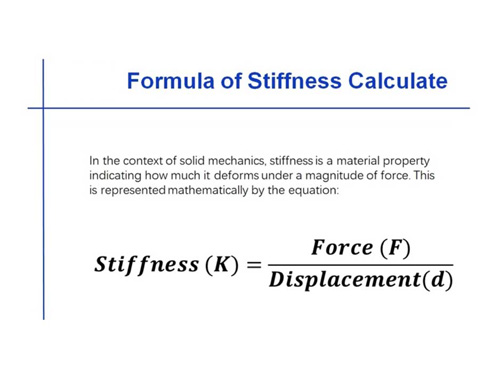
Welcome to Day 6: The Material Selection.
Over the past five days, we've explored the math of stiffness and hunted down where it hides in structural joints. Today, we answer the most practical, boots-on-the-ground question a designer faces: Steel, aluminum, cast iron, granite, carbon fiber, beryllium, Invar, or Zerodur—when you are building a precision machine, which one do you actually pick, and why?
I. The Ashby Method: It's Not Just About the Biggest E
1.1 Performance Indices: Matching Materials to the Mission
Materials scientist Michael Ashby introduced a brilliant core insight to engineering: There is no "best material," only the "best material for a specific set of constraints" [1].
Depending on how a load is applied, materials contribute to stiffness differently, and we measure this using a Material Index.
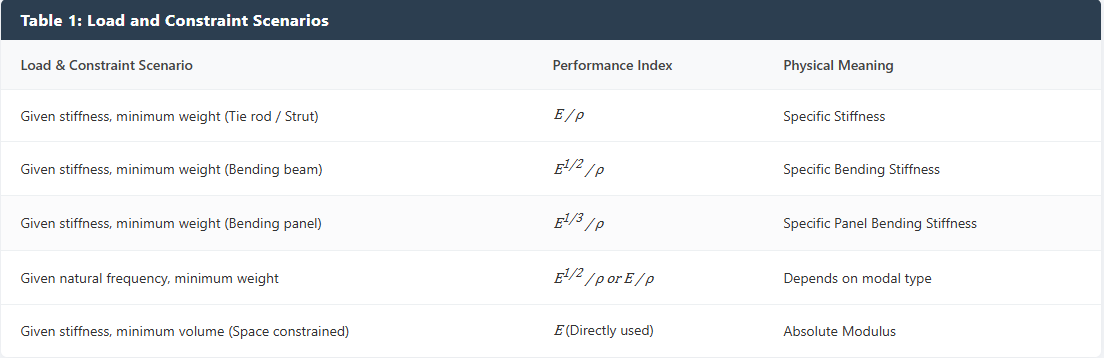
Here is the crucial takeaway: In the world of precision machinery—where bending loads and dynamic frequencies dominate—the most important Material Index is usually E1/2/ρ (the square root of Elastic Modulus divided by density), rather than just E/ρ.
This reveals a profound truth: density (ρ) carries far more weight than your intuition suggests. Shedding weight is an absolute multiplier for a machine's dynamic performance.
1.2 Reading the Ashby Chart
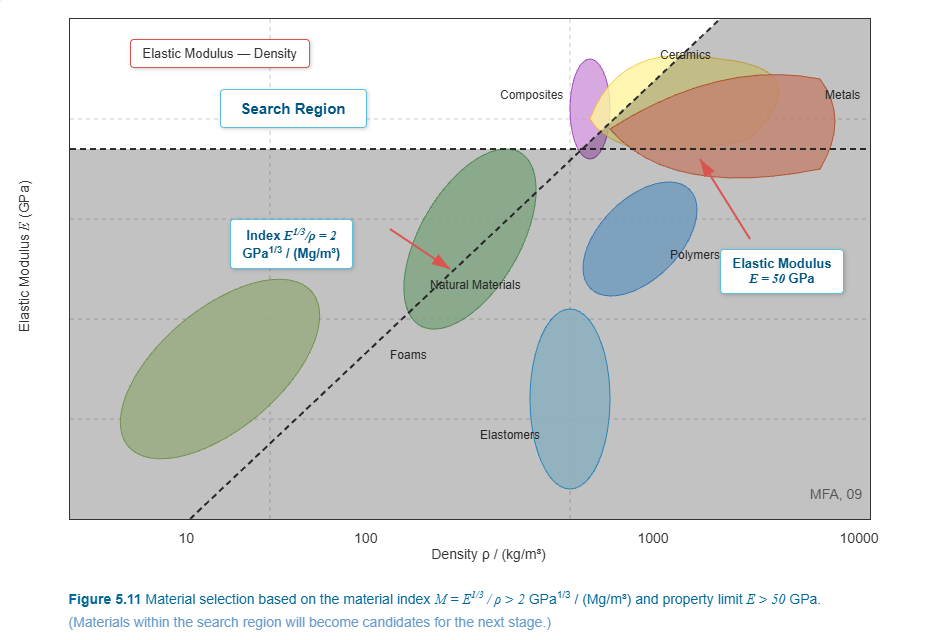
Imagine a graph where every material in the world is plotted as a bubble, with Elastic Modulus (E) on the vertical axis and Density (ρ) on the horizontal. By drawing diagonal lines across this chart, engineers can instantly hunt down the perfect material for their specific constraints [1].
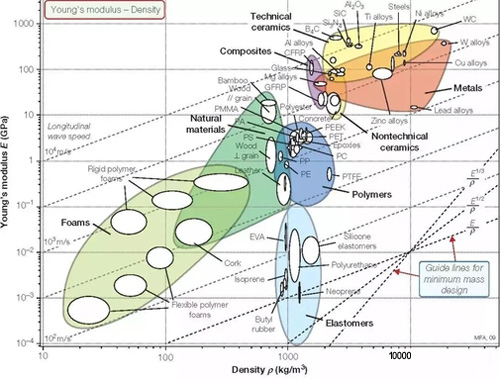
When you look at this chart, Carbon Fiber Reinforced Polymers (CFRP) sit way off to the top left—an absolute outlier offering high stiffness at incredibly low density. If we plotted Beryllium, it would sit high and to the right—offering astronomical performance, but accompanied by terrifying costs in price, manufacturing, and human safety. Both represent materials with incredible on-paper stats, but massive real-world tolls.
(Note: While we can't display the full data table here, let's dive straight into the specialized "files" of these materials to see how they truly perform in the wild.)
1.3 The Master Roster of Precision Materials
Before we put these materials under the microscope one by one, let's lay all their vital stats out on the table for a quick head-to-head comparison.
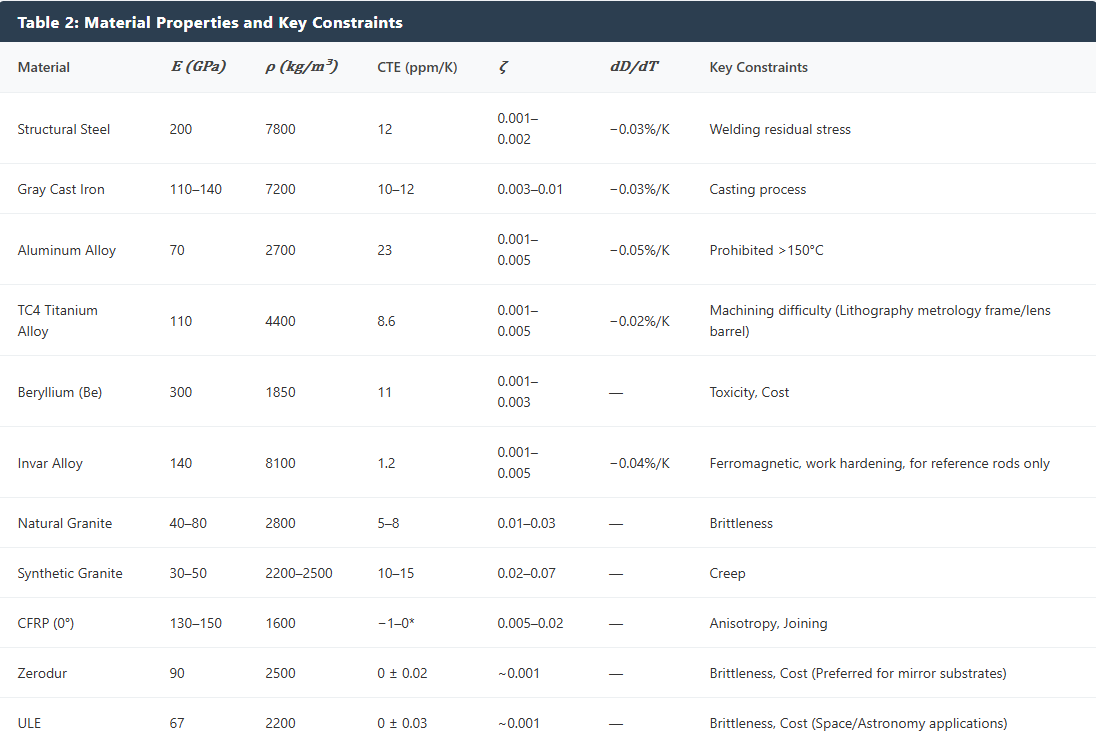
(Note: The data table is implied here.)
*A quick caveat on Carbon Fiber (CFRP): Its Coefficient of Thermal Expansion (CTE) along the fiber direction can actually be negative. This depends entirely on the specific type of fiber used and how the layers are woven together.
II. The Metal Stiffness Files
2.1 Structural Steel
E: ~200 GPa | ρ: 7800 kg/m ³ | E/ρ: ~26 MN·m/kg | Damping (ζ) : 0.001–0.002(Welded)
Steel is the default workhorse of precision machinery. It is absolutely stiff, highly weldable, and cheap. However, welded steel frames have two fatal flaws: terrible vibration damping, and a relatively high Coefficient of Thermal Expansion (CTE ≈12 ppm/K).
The Engineering Reality: A welded steel frame will usually only achieve 60–80% of the stiffness you calculated on your computer. The residual stress from welding and the localized softness in the heat-affected zones steal the rest [2].
2.2 Gray Cast Iron
E: 110–140 GPa | ρ: 7200 kg/m ³ | Damping (ζ): 0.003–0.01
Cast iron is actually softer than steel (its E is about 35% lower). Yet, designers of precision machines are obsessed with it. Why? First, it possesses incredible internal damping—the graphite flakes inside the metal absorb vibrations 3 to 10 times better than steel. Second, it can be poured into complex, reinforced shapes, entirely avoiding the stiffness-destroying heat of welding.
The Engineering Reality: Machine tool beds use cast iron instead of steel not because it is stiffer, but because it is vastly more dynamically stable [2].
2.3 Aluminum Alloys
E:~70GPa | ρ:2700kg/m3 | E/ρ:~26MN·m/kg
Pound for pound, aluminum's specific stiffness (E/ρ) perfectly matches steel. For structures subjected to bending(E1/2/ρ), aluminum actually outperforms steel because it is so much lighter. Furthermore, aluminum can be extruded into incredibly complex, thin-walled hollow shapes that are impossible to make with steel. This is why you see it heavily used in the trusses of aerospace telescopes.
The Warning: Aluminum hates heat. Above 150°C, its stiffness plummets drastically faster than steel's. Use it in hot environments at your own peril.
2.4 Titanium Alloys (Ti-6Al-4V)
E:~110GPa | ρ:4400kg/m ³ | E/ρ:~25MN·m/kg
Nobody chooses Titanium for its cost-effectiveness. It is selected for a highly specific quartet of traits: high specific strength, extreme corrosion resistance, vacuum compatibility, and it is non-magnetic.With a CTE of around 8.6 ppm/K, it is often used in optical systems as a cheaper, non-magnetic alternative to Invar.
2.5 Beryllium
E: ~300 GPa | ρ: 1850 kg/m ³ | E/ ρ: ~162 MN·m/kg
Beryllium is the undisputed king of specific stiffness—nearly 6 times stiffer than steel by weight. This is precisely why the James Webb Space Telescope (JWST) used Beryllium for its iconic golden hexagonal mirrors. It wasn't for optical clarity; it was because only Beryllium could survive the violent shaking of a rocket launch without warping, while remaining light enough to actually fly [3].
The Catch: Beryllium dust is highly toxic (causing berylliosis in lungs), it requires strictly controlled machining environments, and it costs roughly 100 to 200 times more than steel. It is reserved exclusively for the ultimate lightweight applications: aerospace and high-end optomechanics.
2.6 Invar (Fe-36Ni)
E: ~140 GPa | ρ: 8100 kg/m ³ | CTE: ~1.2 ppm/K
Invar is heavy, incredibly difficult to machine, and not particularly stiff. It has exactly one superpower: it barely expands when heated. Its CTE is one-tenth that of steel. In multimillion-dollar EUV lithography machines, Invar is used for Metrology Rods to ensure the measurement reference points do not drift as the machine warms up.
The Achilles Heel: It is 64% iron, meaning it is highly magnetic. If your precision system relies on magnetic fields or electron beams, Invar will ruin your data. In those cases, you must switch back to Titanium [4].
III. The Non-Metals and Composites
3.1 Natural Granite and Gabbro
E:40–80GPa | ρ:2800–3000kg/m ³ | Damping(ζ):0.01–0.03
Granite isn't very stiff, but it possesses three irreplaceable traits:massive internal damping (over 10x that of steel), excellent thermal stability (it takes a long time to heat up), and zero creep. Because it has been aging in the earth for millions of years, its atomic lattice is perfectly relaxed. This makes it the ultimate foundational material for Coordinate Measuring Machines (CMMs) [4].
3.2 Polymer Concrete (Epoxy Granite)
E: 30-50 GPa | ρ: 2200–2500 kg/m ³ | Damping (ζ): 0.02–0.07
This material has an even lower E than natural granite, but it boasts the highest vibration damping of any structural material in existence. It can be cast at room temperature, allowing engineers to easily embed threaded inserts and cooling pipes right into the frame. It is the undisputed king for ultra-precision grinding machines, where even a microscopic vibration at the cutting tool will ruin a mirror finish [2].
3.3 Carbon Fiber Reinforced Polymers (CFRP)
CFRP is not a single material; it is a highly customizable, anisotropic composite. Along the direction of the fibers, its specific stiffness is more than 3 times that of steel. But its "stiffness" comes with three fatal traps [4]:
1.Anisotropy: It might have an E of 150 GPa along the fiber, but a miserable 8 GPa across it.
2.Assembly Nightmares: You can't weld it. The moment you bolt CFRP pieces together, the flexibility of the bolted joints instantly eats up all your on-paper stiffness advantages.
3.Moisture Swelling: The resin matrix absorbs humidity and swells, fighting against the carbon fibers and inducing internal stress.
CFRP is a miracle material in the dry, stable vacuum of space. On the factory floor, these three issues often render its theoretical advantages useless.
IV. Optomechanics: When Stiffness Meets Thermal Stability
In the realm of Optomechanical Systems (like semiconductor lithography or space telescopes), the game isn't just about bending—it's about the product of Stiffness and Thermal Expansion (CTE) [4].
The optical reference frame in a lithography machine must remain nanometer-stable, even if the room temperature fluctuates by just ±0.01℃. If you use a material with a CTE of 5 ppm/K for a 1-meter reference rod, a 0.01℃ change causes it to grow by 50 nanometers. In the EUV world, that completely destroys your overlay accuracy budget.
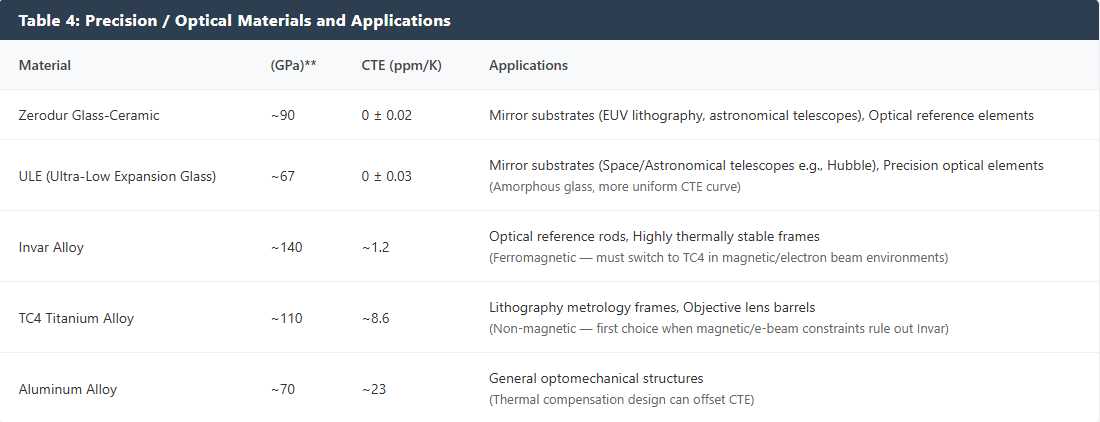
This is why specialized glass-ceramics like Zerodur (Schott AG) and ULE (Corning) exist. Their Elastic Modulus isn't special, but their CTE is effectively zero. In the sub-nanometer world, thermal expansion is a far more terrifying enemy than physical force, because you cannot use geometric design to "stiffen" your way out of it. You must eliminate it at the atomic level.
V. The Ignored Variable: Temperature and Stiffness (dE/dT)
Here is a fact that software often lets you forget: Elastic Modulus is not a constant. It melts away with heat.
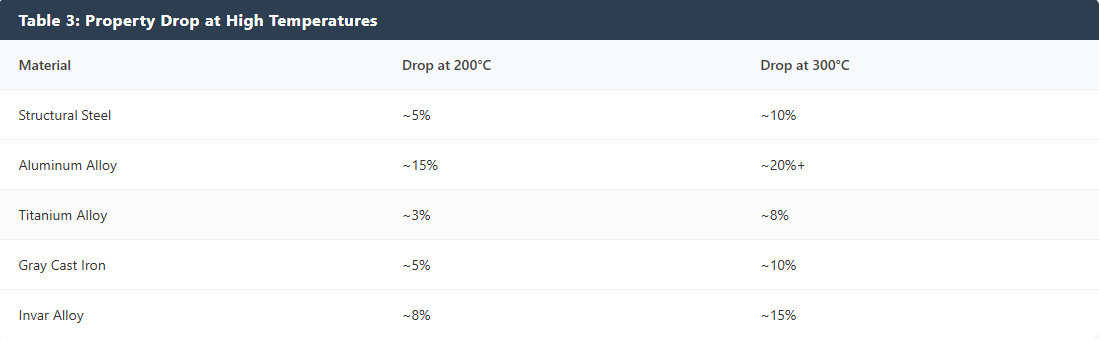
If your precision machine generates internal heat from spinning motors, friction in bearings, or heavy cutting, you must account for dE/dT. At 200°C, aluminum has already lost 15% of its structural stiffness—decaying three times faster than steel [2]. If you built a lightweight aluminum frame and didn't install active cooling, your "specific stiffness advantage" simply vanishes the moment the machine warms up.
VI. The Decision Framework
The next time you are staring at a blank CAD screen trying to choose a material, do not ask, "What is the best material?" Ask yourself these questions:
What is the primary constraint? Is it Volume (choose high E)? Weight (choose high E1/2/ρ)? Cost (default to steel/cast iron)? Or Thermal Stability (choose extremely low CTE)?
How is the force applied? Tension/Compression → look at E/ ρ. Bending → look at E1/2/ρ.
Are vibrations going to kill the process? If yes, prioritize ζ (damping) over E, and immediately look at cast iron, granite, or polymer concrete.
How hot will it get? Room temp → aluminum is fine. >100°C → switch to steel or titanium. >200°C → ban aluminum from the design.
How will we build it? Needs casting → Cast iron / Epoxy granite. Needs welding → Steel. Needs complex thin walls → Aluminum extrusion.
There is no magical material that rules them all. There is only the material that perfectly threads the needle of your specific constraints. Ashby didn't give us the answer key; he gave us the map. You define the boundaries, and the physics will tell you exactly where to go [1].
References
[1] Ashby, M. F., Materials Selection in Mechanical Design, 5th ed., Butterworth-Heinemann, 2017, Ch.3–5. (The definitive methodology for mechanical material selection. The concepts of Material Index and Ashby charts originate from this classic text.) Note: This article is adapted from the WeChat public account "Mechanical Architect", edited for educational exchange. Copyright belongs to the original creator.
[2] Rivin, E. I., Stiffness and Damping in Mechanical Design, Marcel Dekker, 1999, Ch.4 "Material Properties Related to Stiffness and Damping". (The source for core data such as temperature coefficients of elastic modulus and damping comparisons between cast iron and welded steel.)
[3] Yoder, P. R. and Vukobratovich, D., Opto-Mechanical Systems Design, 4th ed., CRC Press, 2015, Ch.3 "Material Properties for Optomechanics". (The authoritative literature on material selection for optomechanical systems, containing complete engineering files for Beryllium, Zerodur, ULE, and Invar.)
[4] Schmidt, R. M., et al., The Design of High Performance Mechatronics, 2nd ed., IOS Press, 2014, Ch.11 "Materials for Precision Mechatronics". (A classic text from the Dutch school of precision mechatronics material selection.)